Most ecommerce support tools are built to answer questions. A customer asks where their order is, and a help article or chatbot replies with a policy and a link.
The question is answered, but the issue usually isn’t. The customer still needs to change an address, skip a shipment, swap a product, or fix a billing problem, so they email, call, or open a chat, and a ticket lands on your team anyway.
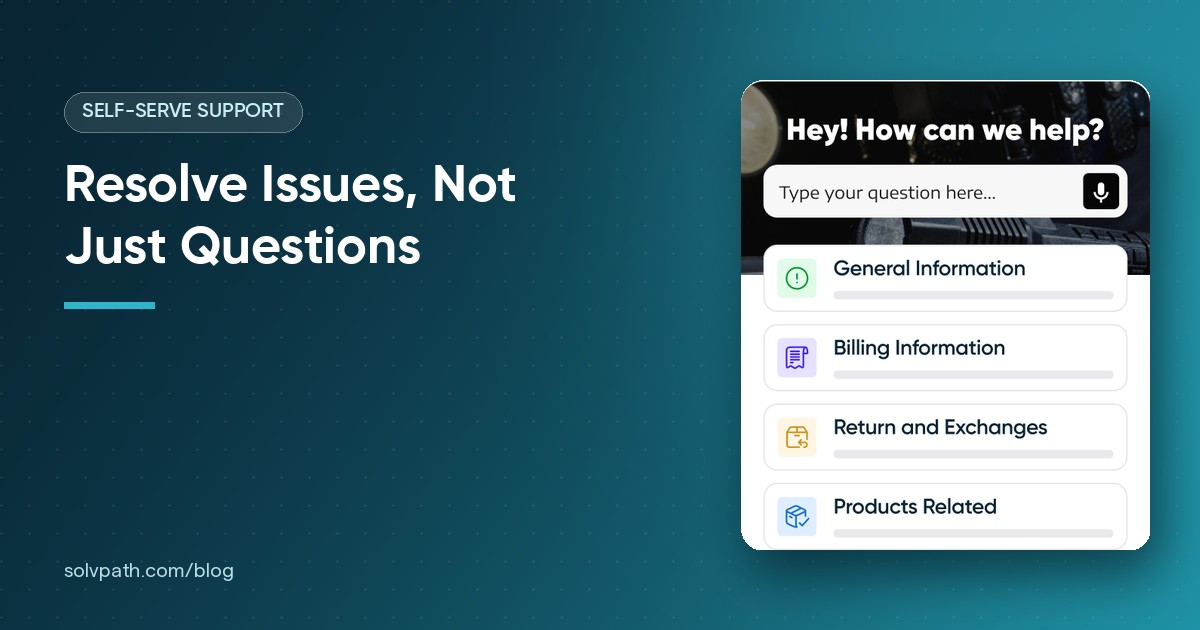
Solvpath takes a different approach. It converts phone calls, digital experiences, website visitors, and emails into one branded, self-service visual experience where customers resolve the issue themselves in a few clicks. This is ecommerce support automation that resolves issues, not just questions, and it gives you the data to understand what’s actually happening across your customer base.
Key takeaways
- Most support tools answer questions. Solvpath resolves the issue, with visual self-service actions customers complete in a few clicks.
- Phone calls, emails, website visitors, and chat all become one branded, visual self-service experience.
- Solvpath is not a ticketing system: it resolves what it can up front and hands the rest to the help desk your team already uses.
- Structured flows show where, why, and what is happening, so you can fix root causes instead of absorbing the same questions every month.
Why “answering questions” isn’t enough for DTC brands
For a DTC brand, support isn’t a cost center you can ignore. It’s where customers decide whether they trust you enough to buy again. When the only automation available is a knowledge base or a generic chatbot, three things tend to happen:
- Tickets still pile up. The customer read the answer, but they still need someone to take an action on their order or subscription.
- Every channel works differently. Phone, email, chat, and your website each give a different experience, and none of them look or feel like your brand.
- You lose the story behind the contact. A ticket tells you someone reached out. It rarely tells you where in the journey it happened, why, or what would have prevented it.
Solvpath was built to close all three gaps.
“The question is answered, but the issue usually isn’t.”
One branded, visual experience across every channel
Solvpath sits in front of your existing support channels and automates inquiries before they become tickets. Whether a customer calls, emails, chats, or simply lands on your site, Solvpath turns that moment into a controlled digital experience that carries your branding, with full control over every flow, design, and outcome.

Phone calls that turn into visual self-service
Solvpath’s phone automation listens, translates, and understands caller intent in real time. It asks targeted questions to identify who the caller is and what they need, then provides an instant answer, routes them to a visual self-service flow, or both. Instead of long hold times, the caller gets a faster outcome, and a support call can become a retention opportunity.
Emails resolved with context
Email automation analyzes inbound messages for intent, sentiment, and customer context. Using ecommerce-trained AI, it delivers personalized responses designed to close out a high percentage of inquiries automatically, with automation first and your agents second.
Website visitors and chat
Solvpath’s AI chatbot is powered by tens of millions of real ecommerce support interactions, so it understands orders, subscriptions, shipping, billing, and returns. It surfaces answers and actions without an agent, and it adapts its tone, logic, and handoffs to match your brand voice. Behind it sits the Smart Help Desk, an ecommerce-trained knowledge base that answers questions in seconds.
A branded customer portal
Everything comes together in a fully branded portal, available standalone or as an embedded widget, that works with Shopify and non-Shopify orders. Customers can check order status, track shipments, modify or cancel orders, and manage subscriptions on their own. If you run multiple stores or platforms, Solvpath unifies them into a single customer experience while you keep full visibility behind the scenes.

“A typical self-serve tool explains your return policy. Solvpath lets the customer start the exchange.”
Ecommerce support automation that resolves issues, not just questions
The difference shows up in what happens after the customer arrives. A typical self-serve tool explains your return policy. Solvpath lets the customer start the exchange.
A typical FAQ explains how subscriptions work. Solvpath lets the customer skip, reschedule, or swap, right there.

That’s why Solvpath is not a ticketing system. It resolves what it can up front, and when human help is genuinely needed, it creates and updates tickets in the tools your team already uses, such as Gorgias, Zendesk, Help Scout, Richpanel, and Tidio. It works with 10+ leading ticketing systems, so your agents only see the conversations that actually need a person.
According to Solvpath’s product pages, brands that make this shift see results like these:
- An average of 74% of inbound calls, emails, and support inquiries automated.
- An average 55% saved in live agent costs by shifting common inquiries to automation, with many merchants seeing 55%–65% lower support costs.
- An average 25% lift in customer satisfaction, because customers get answers fast and feel taken care of.
- Response times up to 90% faster compared to traditional customer support.
The real advantage: knowing where, why, and what is happening
Automation saves time. Data changes how you run the business. Because every interaction happens inside a structured, visual flow rather than a free-text inbox, Solvpath captures what customers actually do, not only what they type.

Solvpath’s dimensional reports reveal the where and the why behind customer contacts. You can see tickets resolved, cancellations saved, returns deflected, and revenue recovered in one place. That turns support from a reactive queue into an early-warning system:
- Where issues happen: which products, funnels, campaigns, or points in the order lifecycle generate the most contacts.
- Why they happen: the reasons customers give, such as a product “not working,” the wrong item, too much product, or cost, all captured through in-flow surveys.
- What happens next: which flows resolve the issue, which offers customers accept, and where customers still need a human.
For a founder or CX leader, that means you can fix the root cause, whether that’s a confusing product page, a shipping delay, or an offer that isn’t landing, instead of hiring more agents to absorb the same questions every month.
“Automation saves time. Data changes how you run the business.”
How this applies to your DTC brand
Here’s what branded support automation looks like in practice for DTC teams:
- Subscription brands can let customers manage subscriptions themselves while every cancel attempt passes through branded retention flows.
- Brands with high return volume can route return requests into troubleshooting, exchanges, and credits through Solvpath Returns before a refund is issued.
- Multi-brand or multi-platform operators can give customers one portal across Shopify, Recharge, headless setups, and more.
- Lean CX teams can protect their agents’ time for the conversations that need empathy and judgment.
Because Support connects to Retention, Returns, and Analytics, every support moment can also become a retention or revenue moment, all inside the same branded experience.

Getting started is faster than you’d expect
Most merchants are fully up and running within 3–10 business days, with no code required. Onboarding includes a dedicated account manager who helps configure your experience and launch your workflows. Solvpath integrates with Shopify, Shopify Plus, and leading subscription and ecommerce platforms, including Recharge, LOOP, Skio, Stay.ai, OrderGroove, BOLD, Checkout Champ, Sticky.io, and many others.
Resolve more. Answer less. Learn everything.
Your customers don’t want an article. They want the problem fixed, ideally without waiting for anyone. Solvpath gives them a branded, visual way to do exactly that across phone, email, chat, and web, and it gives you the data to understand why they reached out in the first place.
Ready to see it on your own store? Book a demo with Solvpath or explore Self-Serve Support automation.