Returns are a fact of life in ecommerce. You can’t eliminate them, and you shouldn’t try.
A fair, easy return policy is part of why customers buy from you in the first place. But most DTC brands treat returns as a pure cost: approve the request, print a label, issue a refund, and move on.
That approach misses the point. Every return request is a customer telling you something specific about your product, your listing, your fulfillment, or your fit.
Smart ecommerce returns management starts with that signal. If you get into the weeds with the data, returns stop being a necessary evil and become one of the clearest signals you have.
Key takeaways
- Every return request is a customer telling you something specific about your product, listing, fulfillment, or fit.
- A refund is often the most expensive way to resolve a problem.
- Solvpath Returns deflects first with troubleshooting, exchanges, store credit, and replacements, then automates the returns that truly need to happen.
- Return reasons, exchange rates, refund rates, and offer performance show product and marketing exactly where to focus.
Why ecommerce returns management deserves more attention
A refund is often the most expensive way to resolve a problem. You lose the revenue, pay for shipping both ways, and may not be able to resell the item.
Often the customer didn’t need a refund at all. They needed:
- A different size, color, or variant
- Help getting a product to work properly
- A replacement part or replacement product
- Store credit toward something they’d like better
When the only path in your returns portal is “return for refund,” that’s the path customers take. Solvpath Returns is built around a simple idea: deflect first, then automate the returns that truly need to happen.
“A refund is often the most expensive way to resolve a problem.”
What Solvpath Returns does
Solvpath Returns is branded automation that turns returns into retention. It gives customers flexible ways to troubleshoot issues, swap products, or take credit instead of returning, and it makes the returns that do happen fast and frictionless.

Troubleshooting before approval
Many “not working” returns aren’t really product failures. Solvpath’s intelligent troubleshooting flows guide customers through a series of questions to identify the issue before a return is approved. Whether the fix is a few troubleshooting steps, a replacement part, or a replacement product, the customer gets the right resolution and you avoid an unnecessary return.
Exchanges, credits, and offers
Solvpath lets you build return experiences that encourage exchanges, store credit, replacements, and product swaps before a refund is issued. Customers still get a flexible, fair outcome, and you keep more of the revenue.
The Return Offer Builder
The Return Offer Builder gives you full control. Create custom return flows, offers, messaging, and decision paths based on products, order details, return reasons, customer segments, and more.

Every return path can fit your brand and your policies. Return A/B split testing, which compares flows, offers, and messaging in real time, is listed as coming soon.
Smart labels, tracking, and refunds
When a return is truly needed, Solvpath generates branded return labels, tracks shipments in real time, and can trigger instant refunds. With support for 40+ fulfillment carriers, brands can offer live shipment tracking, faster localized returns, and access to better return label rates, all in one platform.
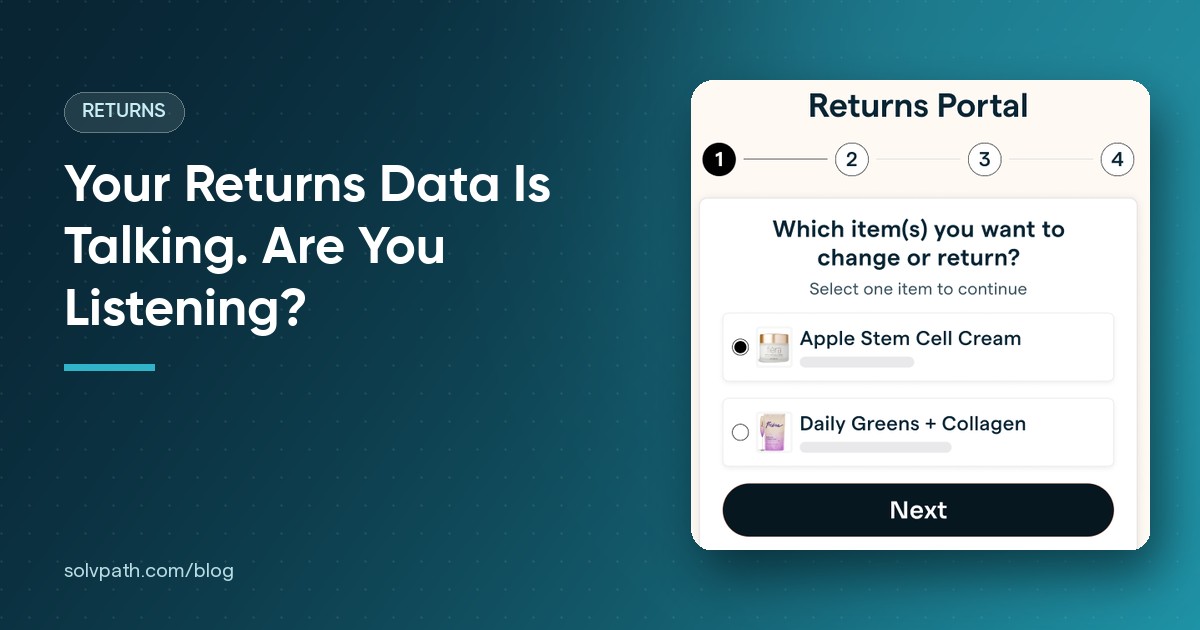
A branded returns portal
Customers can start a return or exchange from anywhere on your site through a fully branded, self-service portal, standalone or embedded, that works with Shopify and non-Shopify orders.
“Deflect what’s avoidable, automate what’s necessary, and learn from all of it.”
Getting into the weeds: what your returns data can tell you
This is where returns get interesting for operators. Solvpath tracks return reasons, exchange rates, refund rates, store credit usage, offer performance, and overall return trends. Used well, that data answers questions most brands can’t:
- Which products drive the most returns, and why? A spike in “not as described” on one SKU points to a product page problem, not a product problem.
- Which issues are fixable without a return? If troubleshooting resolves a large share of “not working” requests, that’s a gap in onboarding or instructions you can fix upstream.
- Which offers actually land? Comparing exchange, credit, and incentive take rates shows what your customers value and what protects your margin.
- Are refunds trending up or down? Watching refund rates against exchange rates over time tells you whether your deflection strategy is working.
- Where should product and marketing focus? Return reasons by product and segment are direct feedback on fit, quality, sizing, and expectations set by your ads.

Because Solvpath Returns connects to Support, Retention, and Analytics, you see returns in the context of the whole customer journey, not as an isolated warehouse metric.
“Every return request is a customer telling you something specific about your product, your listing, your fulfillment, or your fit.”
The results brands are seeing
According to Solvpath:
- Solvpath deflects an average of 18% of return requests through troubleshooting, exchanges, and credits.
- Offering troubleshooting, exchanges, credits, and incentives reduces refunds by 25%.
- Automated workflows help cut manual work by up to 70% across the returns process.
One testimonial on Solvpath’s site describes smart swap and save offers helping a leading supplement brand retain over half of return-related revenue, while automated exchange flows and upgrade offers boosted upsell value by $1.81 per return for a fashion retailer.

How this applies to your DTC brand
Whether you sell supplements, skincare, apparel, or hard goods, a smarter returns program follows the same playbook:
- Audit your return reasons. Group them into fixable, exchangeable, and true refunds.
- Build a path for each. Troubleshooting for “not working,” exchanges for fit and variant issues, and credits or incentives for “changed my mind.”
- Keep it easy. Deflection works best when customers feel helped, not blocked. A branded, fast portal builds trust.
- Review the data monthly. Share return insights with product, merchandising, and marketing so fewer returns happen in the first place.
Returns also connect naturally to the rest of your post-purchase experience. A customer starting a return might really be a subscriber who wants to change their plan, which is where Solvpath Retention comes in.

A customer with a product question might be best served by Self-Serve Support before a return is ever needed. Most merchants are up and running within 3–10 business days with no code required, with a dedicated account manager guiding setup.
Turn your returns into retention
Returns will always be part of ecommerce. Losing revenue, and the lessons inside every return request, doesn’t have to be. Solvpath helps you deflect what’s avoidable, automate what’s necessary, and learn from all of it.
See what your returns data could be telling you. Book a demo with Solvpath or explore Solvpath Returns.